

Summer Reading Lab
Intentional, small-group (six-eight students max) literacy instruction centered on close reading— methodology designed to deepen comprehension, strengthen analytical reading skills, and foster lasting academic confidence.
For students entering grades 8-10

Literacy development * FAST Test Prep Strategies * Critical Thinking and Analysis
What is the Reading Lab?
StudySesh’s Strategic Reading & Literacy lab is a one-week summer camp (two hours daily) for students entering grades 8-10 who want to strengthen comprehension, expand vocabulary, and refine analytical thinking. Through a close reading analysis program, this class teaches students how to approach reading strategically and develop the skills required for success in rigorous high school classes, higher scores on the FAST exam, and future SAT and ACT preparation. Reading Lab is capped at six to eight students to maintain a high level of individualized instruction and meaningful discussion.

Why Enroll in the Close Reading Lab?
Many capable students tackle a text but don’t quite extract meaning, structure, or evidence — and that gap shows up in class, essays, and exams.
Close reading builds stronger, more strategic readers
Many capable students understand what they read but struggle to analyze, explain, or apply it consistently. Close Reading Lab teaches students a clear, strategic process for breaking down complex texts, identifying evidence, and articulating ideas with precision.
As academic expectations increase, these skills become essential — strengthening classroom performance, standardized test readiness, and long-term academic confidence.
Which Students Will Benefit from the Reading Lab?
This class is ideal for rising 8th-10th-grade students who:
Are capable students who want to build stronger analytical skills for rigorous high school-level courses
May be preparing for honors, AP, or college-level coursework
Sometimes understand reading passages but struggle to articulate their deeper meanings
Sometimes finish a text and struggle to remember what they just read
Want to improve efficiency and confidence when reading challenging material

Intentional Close Reading: How it Builds Reading Gains
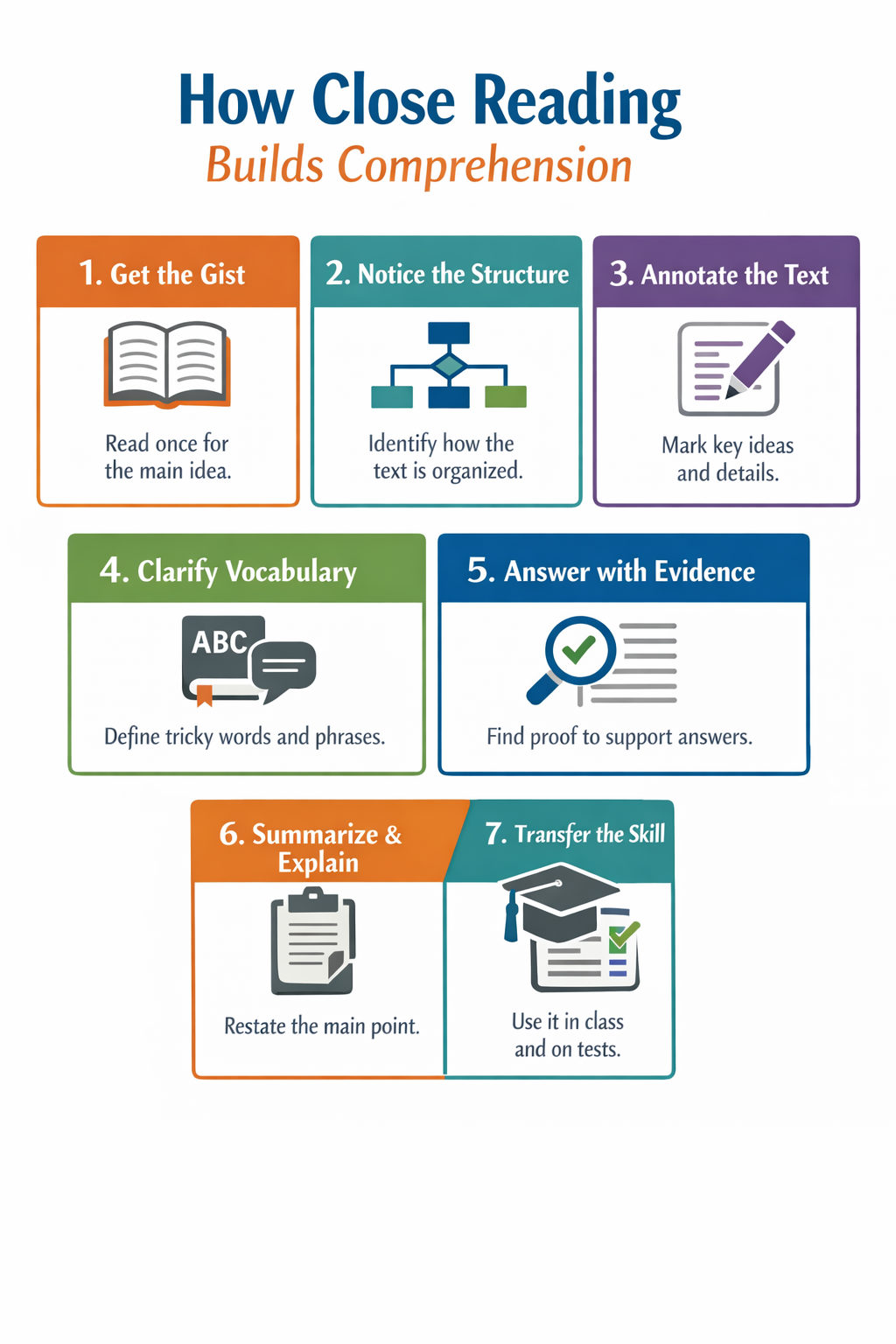
Close reading is a repeatable strategy that teaches students how to think about a text — not just to read it.
How Close Reading Works
1. Read for Understanding
Students first identify the main idea and purpose of the text.
2. Analyze the Structure
We examine how the text is organized and how ideas are developed and supported.
3. Clarify vocabulary
Students use context clues and definitions to learn unknown words.
4. Annotate with Intention
Students mark key ideas, vocabulary, transitions, and shifts in meaning.
5. Support with Evidence
Students answer text-based questions and defend their thinking using proof.
6. Summarize and Transfer
Students articulate the author’s message clearly — and apply the process across subjects and assessments.
Close reading isn’t about reading more — it’s about reading with purpose, clarity, and growing independence.
Program Information

Grade Level
Rising 8th-10th graders
Date Options
June 8, 2026 - June 12, 2026
July 27, 2026 - July 31, 2026
Time
10:15 am - 12:15 pm daily
Location
Jan Platt Library (projected)
Available Seats
Six-eight students per class
Sample Weekly Structure
Two-Hour Daily Sessions | Three Core Texts | Multiple Rereads
Monday – Text 1 (Fiction)
Overview of Close Reading
First read: comprehension check, guided annotation, text-based questions
Second read: structure, tone & diction
Small-group discussion
Multiple Choice questions and review
Focus: Moving from surface understanding to deeper analysis.
Tuesday – Text 1 (Revisited)
Targeted reread: Inferences practice themes/lessons
Vocabulary in context exercises
Identifying and evaluating textual evidence
Short analytical writing using textual evidence
Focus: Supporting ideas with precise textual evidence.
Wednesday – Text 2 (Informational/Argument)
First read: comprehension check, guided annotation, text-based questions
Annotate key transitions
Guided discussion
Second read: central idea, author’s purpose, Inferences practice
Analyze the structure and organization of the passage
Focus: Strengthening nonfiction comprehension and argument analysis.
Thursday – Text 2 (Revisited) + Text 3 Intro
Reread key sections of Text 2: Identifying and evaluating evidence
Group inferences project
First read of Text 3 (literary nonfiction or poetry)
Vocabulary deep dive
Figurative language in non-fiction study
Focus: Reading strategies across fiction and non-fiction
Friday – Text 3 (Revisited) + Synthesis
Close reread for theme/central ideas
Discussion of imagery
Comparing similarities and differences across texts
Short written synthesis
Discussion
Focus: Independent application of the close-reading process
Register Now For June or July
Frequently Asked Questions
Still have questions? Take a look at the FAQ or reach out anytime. If you’re feeling ready, go ahead and register!
-
The reading lab is taught by Stacy Malin. Stacy is a former Hillsborough County English teacher; she holds master’s degrees in Teaching English to Speakers of Other Languages and in Educational Leadership. Stacy has over 10 years of classroom ELA experience and extensive training in curriculum development. She has taught English. Stacy enjoys helping students develop reading and analytical skills.
-
Summer Reading Lab is a one-week commitment from M-F for two hours each day.
-
Reading Lab is a $300 investment.
-
This lab teaches the thinking skills behind strong reading — so students not only understand what they read but can explain it, justify it, and use it across subjects and assessments. The class is taught by a passionate, skilled teacher who knows just how to incrementally improve your child’s reading ability and prepare him or her for the next level.
-
Stronger reading comprehension
Improved vocabulary and academic language
Greater confidence and independence
Preparation for honors, AP, and college-preparatory coursework
Foundation for future SAT and ACT preparation
-
Click above on the “Register” button in blue. Once you pay for the class your seat will be reserved.
-
Enrollment & Payment
Full payment is required to reserve a student’s seat in the Reading Lab. Enrollment is confirmed only upon receipt of payment through the Squarespace checkout system. Spaces are limited due to the small-group format.
Cancellation & Refund Policy
Because Reading Lab enrollment secures a limited seat in a small-group setting, the following refund policy applies:
Cancellations made 14 days or more prior to the start date are eligible for a full refund (minus processing fees, if applicable).
Cancellations made 7–13 days prior to the start date are eligible for a 50% refund.
Cancellations made within 7 days of the start date are non-refundable.
If StudySesh cancels the program for any reason, families will receive a full refund.
Attendance Policy
Reading Lab is structured as a cumulative academic program. Each session builds upon prior instruction.
No make-up sessions are offered for missed classes. Materials from missed sessions may be provided when possible, but in-person instruction cannot be replicated.
Student Conduct
Reading Lab is a focused academic environment. Students are expected to participate respectfully and engage thoughtfully in discussion and written work.
StudySesh reserves the right to dismiss a student whose behavior significantly disrupts the learning environment. In such cases, tuition will not be refunded.
Academic Disclaimer
Reading Lab is designed to strengthen comprehension, analytical reading, and academic confidence. While many students experience measurable growth, StudySesh does not guarantee specific grades, test scores, or academic outcomes.
Assumption of Risk & Liability
By enrolling, parents/guardians acknowledge that their child is participating voluntarily in an in-person academic program. Parents/guardians agree to release and hold harmless StudySesh LLC from liability for injuries or damages arising from participation, except in cases of gross negligence.
Guardianship
Please make sure students have reliable transportation to and from the Reading Lab. StudySesh is not responsible for student welfare outside of the course time.
Agreement to Terms
Enrollment in Reading Lab constitutes agreement to the policies outlined above.
Want to Chat First?
To book now or contact directly:
email: info@studyseshllc.com
phone: (813) 421-4716
Or, fill out some info, and we will be in touch shortly. We can’t wait to hear from you!